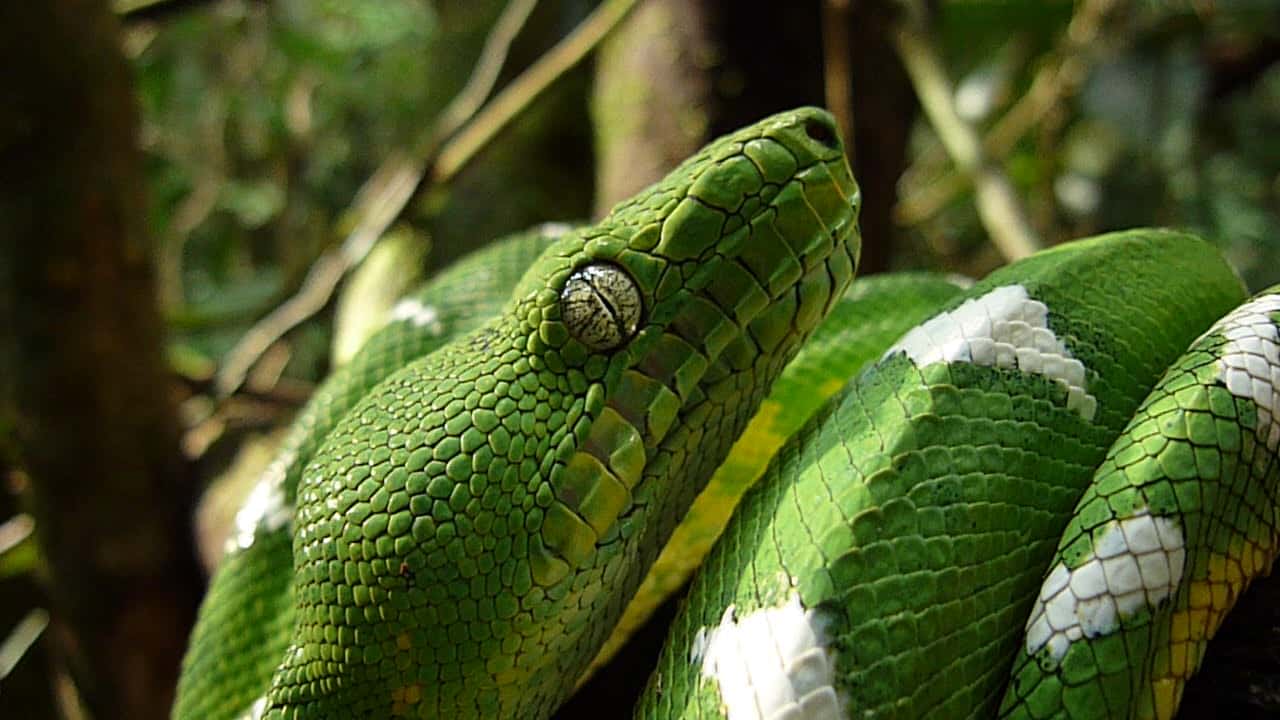
The Amazon Rainforest snakes have covered every niche the forest has created, from the canopy to the ground, inside soil, and inside water.
If you are walking through and spot a whip snake resting on dead branches across your path, it is a signal that the forest is always in motion, sometimes canoeing along rivers or oxbow lakes, and catch sight of a giant anaconda coiled, you cannot help but feel excited.



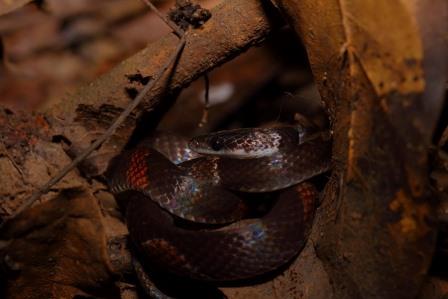
Calico is a ground-dwelling snake, found in the flooded forest of the Yasuni Biosphere Reserve.
Anaconda
Anacondas are the world’s heaviest snake at around 250 kg. They can grow about 10 metres and have a semi-aquatic lifestyle made possible by the position of their eyes and nostrils on the tops of their head. They seem to choose areas with thick vegetation (grassy areas ), piles of dead logs where they hide. They hunt mainly at night, eating the most manageable animals like capybara, peccaries, and deer. It likes forest streams.
Amazon Whip Snake
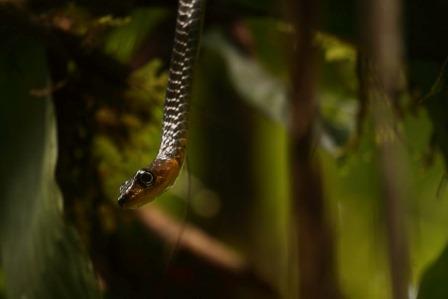
Chironius Whip Snake exploring for prey
Snakes in this genus (Chironius) are among the most abundant in all South American forests. They include both ground-living and canopy-living diurnal species that mainly prey on frogs but also take lizards and birds.
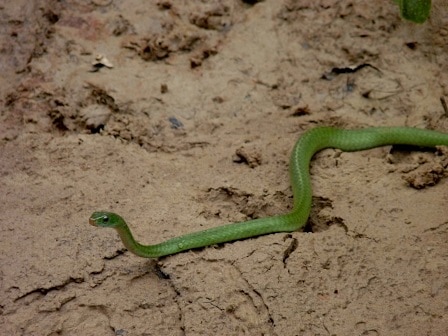
Chironius Whip Snake lives in the canopy of the Amazon Rainforest. Yasuni Biosphere Reserve.
Chironius seeks prey in shrubs and trees. Smart for a snake, there are records of this species investigating bromeliads for their frog prey. Bromeliads collect water, making a perfect home for frogs.
Bushmasters

Bushmaster molting: notice the whitish eye. Yasuni Biosphere Reserve. Photo by our guide Daniel Hicks
Bushmasters are a formidable South American viper and are the largest venomous snake in the western hemisphere. Bushmaster is a very large snake, often exceeding 6,5 ft (2 m) in length. But they can grow to be over 12 ft (3.5 m), making them the longest venomous snake found in the Americas. Strangely for a neotropical pitviper, bushmasters lay eggs as opposed to giving birth to live young.
Fer-de lance
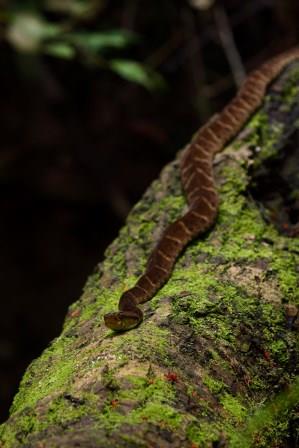
Fer-de-lance resting along the trunk we used for crossing. Yasuni Biosphere Reserve.
Fer-de-lance are nocturnal and solitary. It can be found near rivers and streams, basking under the sun during the day and lying still while well camouflaged in leaf litter or under forest cover, waiting to ambush prey (including rats and mice) that comes within range during the night. When cornered or threatened, this species can be very defensive and may exhibit an S-coiled defense display. Juveniles are often semi-arboreal, and even adults are sometimes encountered in bushes and low trees.
Emerald Tree Boa
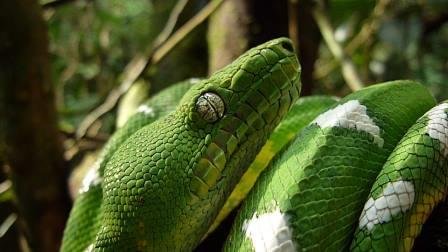
Emerald Tree Boa lives in the canopy, although it can come to lower vegetation. Active at night. Yasuni Biosphere Reserve.
Emerald tree boas live in the trees and blend into the leafy background. They often use their strength to hang from branches and snatch prey like mammals and birds. They have white markings over their body and are locally common in the Amazon Rainforest. Juveniles of this species are reddish orange and then mature to a magnificent green.
Rainbow Boa
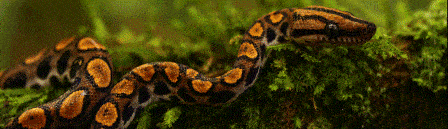
Rainbow Boa, it lives inside leafcutting ant colonies. Yasuni Biosphere Reserve.
Rainbow Boas have iridescent scales -they shine in any direction or angle- giving this boa its common name. They feed on birds, lizards, and small mammals found in their range of northern and central South America. It can be found inside leafcutter ant colonies. Rainbow boas are very popular in the pet trade due to their beautiful colouration.
Boa Constrictor
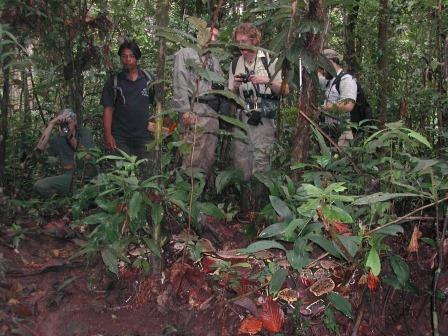
Boa Constrictor resting in front of Amazon explorers, Yasuni Biosphere Reserve.
Boa constrictors are a very distinct snake. Their colouration depends on habitat, and there are many different subspecies.
Although proficient swimmers, they prefer a more land-based lifestyle and seek safety in mammal-constructed burrows.
Constrictors are dwarfed by their anaconda cousins and grow to around 4 metres in length. Threatening their existence in the wild, boas are hunted for their skins to make various products.
Coral Snake
The South American coral snake is a beautifully patterned elapid (member of the Cobra (Elapidae) family.
Coral snakes vary widely in their behavior, but most are very elusive, fossorial snakes that spend the vast majority of their time buried beneath the ground or in the leaf litter of a rainforest floor, coming to the surface only when it rains or during breeding season.
Some species, like Micrurus surinamensis, are almost entirely aquatic and spend most of their lives in slow-moving bodies of water that have dense vegetation. Coral snakes feed on lizards and other snakes and are highly venomous.


Amazon Tree Boa
As their name suggests, Amazon Tree Boas live mainly in the trees and are classed as arboreal, but they can come down to the ground at night. Like the emerald tree boas, these snakes are also known to hang from trees to catch passing prey. They have varied colouration from an olive body to orange or yellow.
We will continue adding species to this post. Enjoy it!!