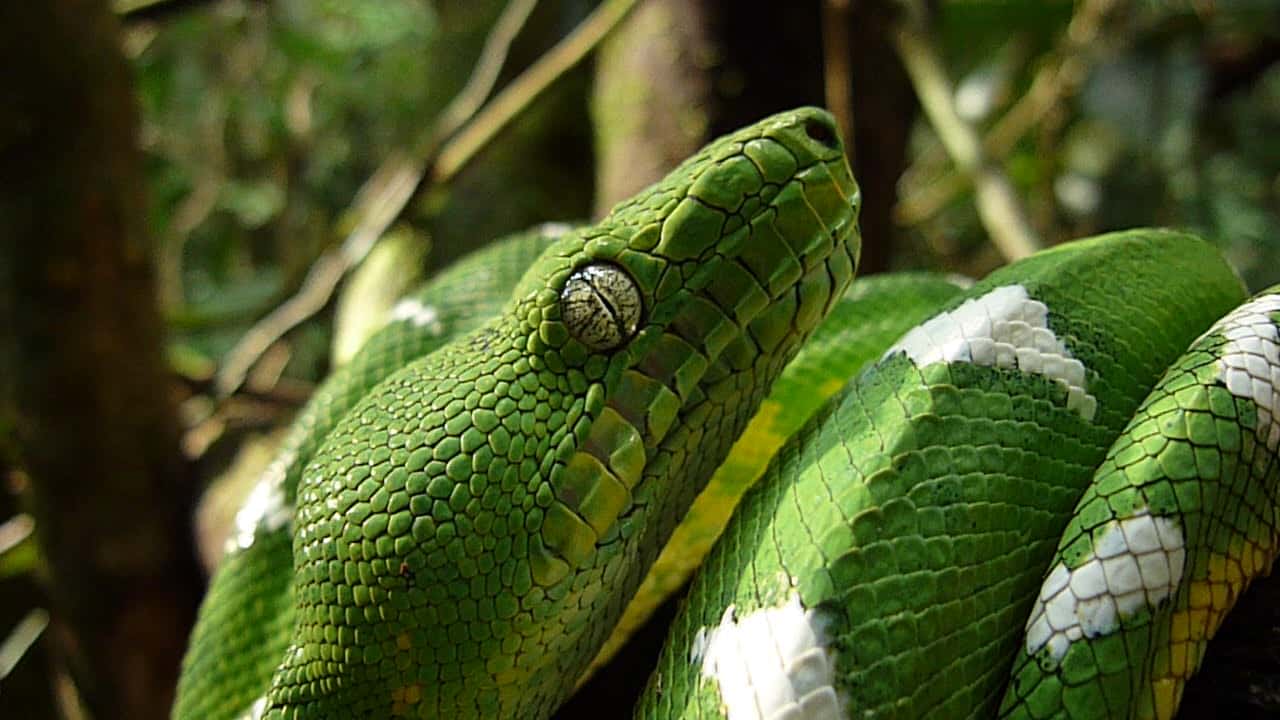
Snakes of the Amazon Rainforest
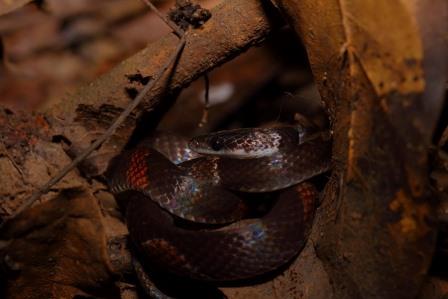
Calico is a ground-dwelling snake, found in the flooded forest of the Yasuni Biosphere Reserve.
A World of Snakes Hidden in the Forest
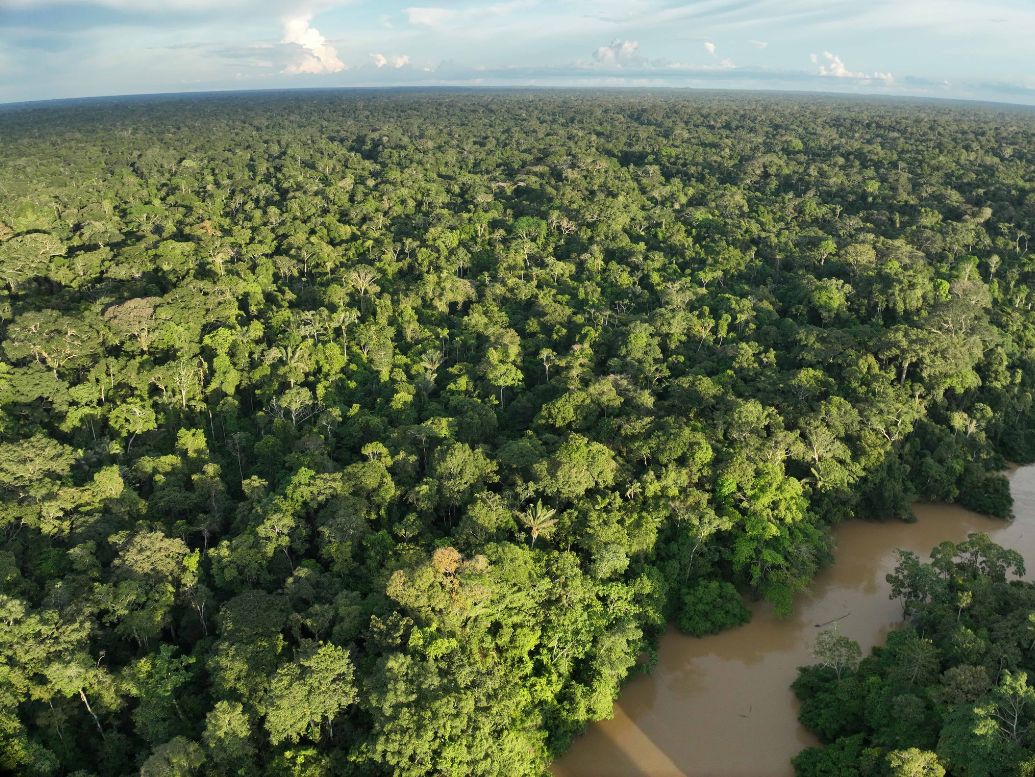
The Amazon rainforest has created an extraordinary variety of habitats—and snakes have found ways to occupy almost all of them.
They move through the canopy, shrubs, leaf litter, fallen trees, forest floor, streams, flooded forests, and even underground spaces.
Want to see snakes like these in the wild? Our night walks are built for exactly this kind of discovery. Join the Amazon Nature Experience.
In the Amazon, the forest is never truly still.
Walk quietly along a rainforest trail, and you might suddenly notice an Amazon Whip Snake stretched across a fallen branch. Paddle slowly along a blackwater stream or oxbow lake and, with extraordinary luck, you may see the unmistakable body of a Green Anaconda resting among aquatic vegetation.
These encounters are rare, unpredictable, and unforgettable.
And they reveal something important about the rainforest: every layer is alive.
Yasuní is one of the world’s great centers of reptile diversity. More than 120 reptile species have been documented in the park, an extraordinary concentration for such a relatively small area.
At Shiripuno, our trails and waterways provide opportunities to discover some of these remarkable animals.
Green Anaconda
The Green Anaconda (Eunectes murinus) is one of the legendary animals of the Amazon.
It is the world’s heaviest snake, although stories of 10–12 metre, 200+ kilogram individuals are often repeated without reliable measurements. Confirmed Ecuadorian records are considerably smaller, with females reaching around 6.6 metres in the available Ecuadorian literature.
Anacondas are perfectly adapted to life around water.
Their eyes and nostrils sit high on the head, allowing them to remain largely submerged while watching and breathing above the surface. Their olive coloration and dark markings provide remarkable camouflage among aquatic vegetation.
They are powerful ambush predators, capable of taking a surprisingly wide variety of prey.
Finding one in the wild is a completely different experience from seeing one in a photograph.
When the only thing separating you from an enormous Amazonian snake is the quiet water of a forest lagoon, you understand just how wild this place really is.
Amazon Whip Snakes
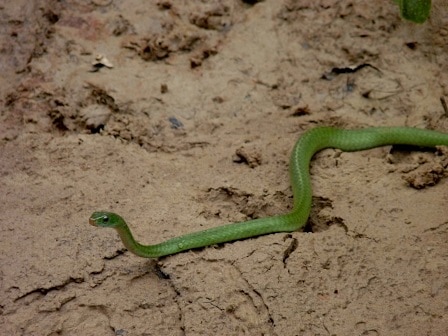
Chironius whip snakes live in the canopy of the Amazon Rainforest. Yasuni Biosphere Reserve.
The genus Chironius contains some of the most agile and fascinating snakes of South America.
These slender, predominantly diurnal snakes can hunt both on the ground and in vegetation. Their prey includes frogs, lizards, and occasionally birds.
They are particularly interesting because they actively explore vegetation in search of prey.
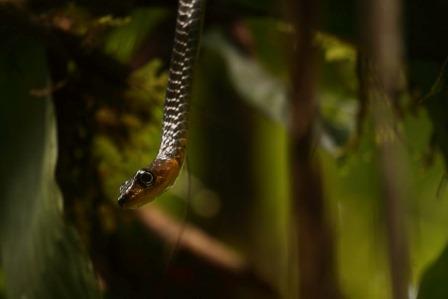
Chironius Whip Snake exploring for prey
One of their favorite hunting environments can be a bromeliad.
Bromeliads collect water between their leaves, creating tiny aquatic ecosystems that may shelter frogs and other small animals.
For a hungry whip snake, these miniature rainforest ponds can become hunting grounds.
So when you see a Chironius moving carefully through the vegetation, it isn’t simply climbing.
It is searching.
Bushmaster

Bushmaster molting: notice the whitish eye. Yasuni Biosphere Reserve. Photo by our guide Daniel Hicks
Few Amazonian snakes have a reputation as legendary as the Bushmaster (Lachesis muta).
It is the largest pit viper in the Americas and one of the most impressive venomous snakes of the Western Hemisphere.
Bushmasters are primarily terrestrial and are often associated with the forest floor, fallen logs, burrows, and other sheltered places.
Unlike most New World pit vipers, Bushmasters lay eggs. This is one of the most unusual aspects of their natural history, and females can remain associated with the nest and eggs.
A remarkable specimen from Yasuní National Park preserved in the zoological collection of the Pontificia Universidad Católica del Ecuador measured 315 cm—one of the largest documented Bushmasters from South America.
Seeing one in the forest is an exceptional encounter.
And one that deserves distance and respect.
Fer-de-Lance
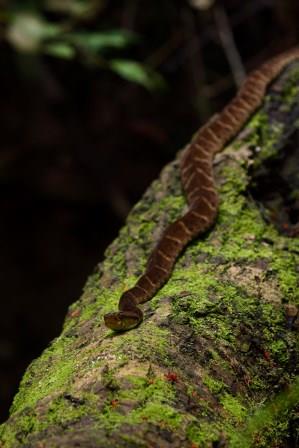
Fer-de-lance resting along the trunk we used for crossing. Yasuni Biosphere Reserve.
The Fer-de-Lance (Bothrops atrox) is one of the most important predators of the Amazon forest floor—and one of the snakes that deserves the greatest respect from anyone walking in the rainforest.
It is primarily nocturnal and relies heavily on camouflage and ambush.
During the day, one may remain almost invisible among fallen leaves, roots, branches, and vegetation.
Juveniles can be more arboreal than adults, occasionally entering low vegetation.
This is a perfect example of why rainforest exploration requires attention.
The snake may be there.
You simply may not see it.
Our guides know how to read the trail, watch where they step, and give wildlife the space it needs.
The goal is observation, never interaction.
Emerald Tree Boa
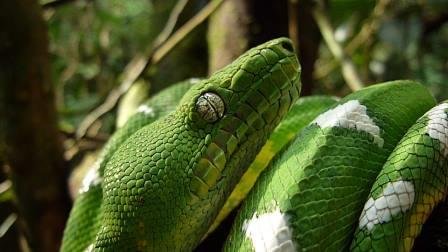
Emerald Tree Boa lives in the canopy, although it can come to lower vegetation. Active at night. Yasuni Biosphere Reserve.
High above the forest floor lives another spectacular predator: the Emerald Tree Boa.
Its brilliant green coloration makes it look almost unreal against the foliage.
This arboreal snake spends much of its life among branches and vegetation, where it waits for prey such as birds and small mammals.
Young individuals can look dramatically different from adults, often displaying reddish or orange coloration before developing the characteristic green of maturity.
In the rainforest canopy, camouflage can be a matter of life and death.
For the Emerald Tree Boa, looking like a leaf-covered branch is an extraordinary survival strategy.
Rainbow Boa
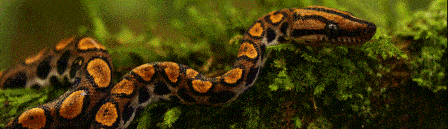
Rainbow Boa, it lives inside leaf-cutter ant colonies. Yasuni Biosphere Reserve.
The Rainbow Boa is named for an optical effect rather than a painted pattern.
Its scales can produce an extraordinary iridescent sheen, appearing to glow with different colors as light strikes the body from different angles.
It is primarily a nocturnal snake and feeds on a variety of small vertebrates, including birds, lizards, and mammals.
Like many Amazonian snakes, it occupies a very specific ecological niche—and its presence reminds us that rainforest biodiversity isn’t only about the spectacular animals we see easily.
Some of the most fascinating species spend most of their lives hidden.
Boa Constrictor
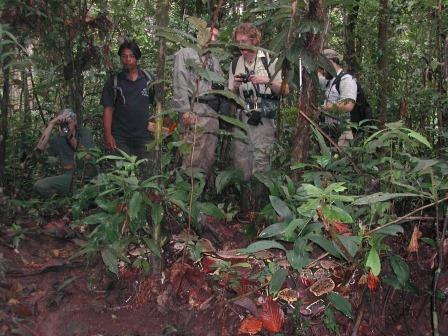
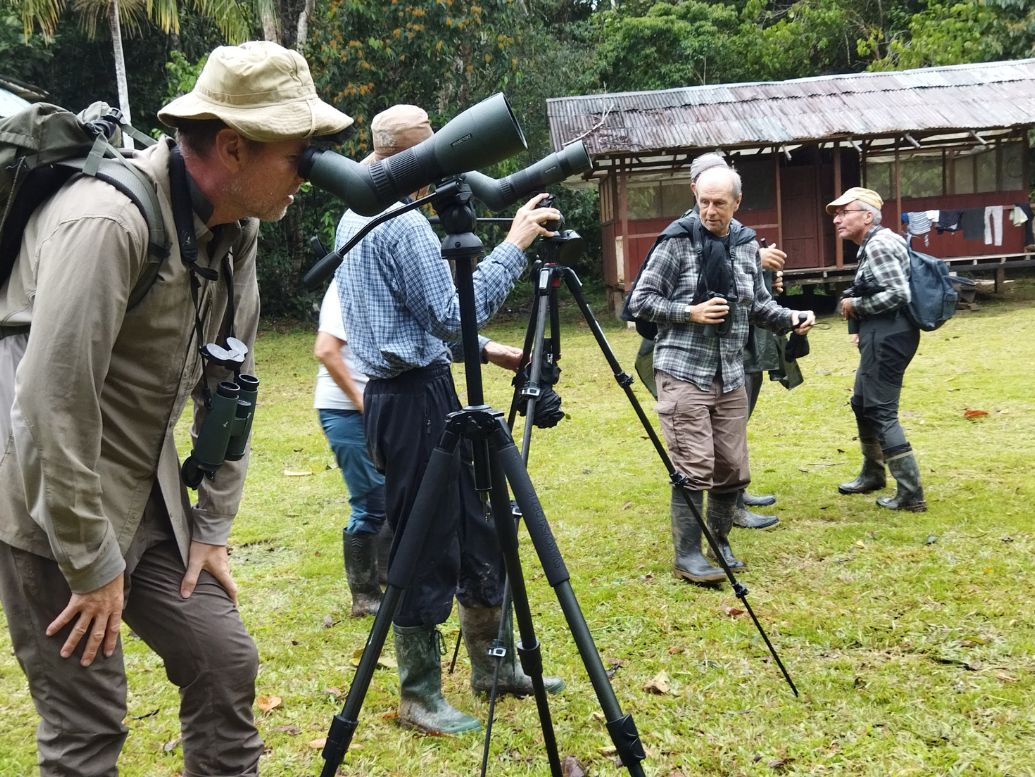
Boa Constrictor resting in front of Amazon explorers, Yasuni Biosphere Reserve.
The Boa Constrictor is one of the Amazon’s most recognizable snakes.
Unlike the highly aquatic anaconda, it is primarily terrestrial, although younger individuals are more likely to climb.
These powerful constrictors use both active searching and ambush to capture prey.
Their ability to move between the forest floor, vegetation, tree cavities, and other shelters makes them remarkably adaptable rainforest predators.
And despite sharing the Amazon with the enormous anaconda, Boa Constrictors are considerably smaller.
Coral Snakes
Among the most beautifully patterned snakes in the Amazon are the coral snakes.
Their brilliant bands are a warning: beauty can be dangerous.
Many coral snakes are secretive and spend much of their lives beneath leaf litter, soil, roots, or other hidden spaces.
But the group is remarkably diverse.
Some species are strongly associated with aquatic environments. Micrurus surinamensis, for example, is closely associated with slow-moving water and dense aquatic vegetation.
These snakes feed on other small vertebrates, including lizards and other snakes.
Their secretive lifestyle means that even experienced naturalists may walk past them without ever knowing they were there.
Amazon Tree Boa
The Amazon Tree Boa is another nocturnal hunter of the forest.
Although primarily arboreal, it may descend to the ground, particularly at night.
Its variable coloration can range from greens and browns to striking yellowish or orange tones.
Like other tree-dwelling boas, it can use vegetation as a hunting platform, positioning itself among branches and waiting for prey to come within reach.
Look carefully into the vegetation after dark.
Sometimes the branch you thought was empty is watching you back.
The Hidden Diversity of Yasuní
These are only a few of the snakes that can be found in the Ecuadorian Amazon.
The remarkable thing about Yasuní is not simply the size of its snakes.
It is the diversity of lifestyles.
Some snakes climb trees.
Snakes that hunt frogs in bromeliads.
Snakes that disappear beneath the leaf litter.
Snakes that specialize in aquatic habitats.
Snakes that wait beside fallen logs.
And snakes that quietly patrol the forest floor at night.
Every one of them occupies a place in the rainforest ecosystem.
Every one tells us something about the extraordinary complexity of Amazonian life.
At Shiripuno, we will continue adding photographs, observations, videos, and natural-history information to this page as our guides and guests encounter new species.
So keep looking.
The next snake may be hiding just above your head.